Screening App Ideas Before You Write Code: Four Questions, Starting With Who Pays
App ideas cost nothing. Every one of them looks shippable in a weekend, and then the weekend turns into three months of auth flows, sync bugs, review notes and a paywall that took longer than the app.
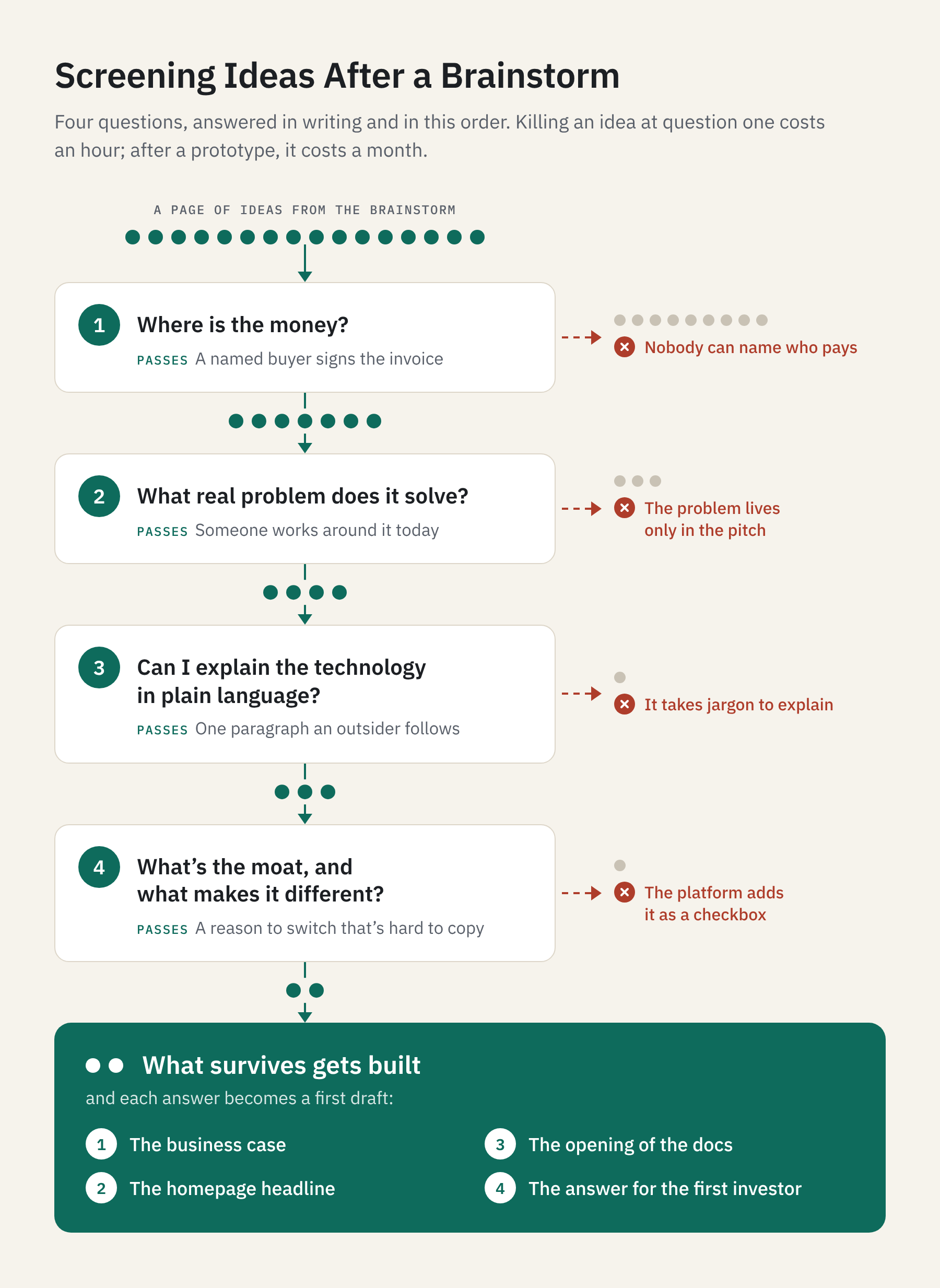
So before Xcode or Android Studio opens, put the idea through four questions and write the answers down. Who pays? What problem does it solve? Can you say what it does in one sentence? Why would anyone switch, and what stops Apple from copying it? Ask them in that order. Money goes first because it kills weak ideas fastest, while a kill still costs an evening.
Where Is the Money?
Among new subscription apps, fewer than one in five reach $1,000 a month in revenue within two years. Fewer than one in twenty reach $10,000. And those are apps that bothered to set up a paywall.
So “people will pay for this” doesn’t count. Name the payer and the pocket. A consumer pays at a paywall, up against Netflix and Spotify for the same monthly budget. A business pays out of a manager’s budget, and a tool that saves a team five hours a week gets expensed without a meeting.
Then look for money that’s already moving. Open the top-grossing chart in your category and read your competitors’ in-app purchase prices on their App Store pages. That’s your market’s price list. Watch for the free default too: nobody pays for a plain to-do list when Reminders comes with the phone. People pay for what the defaults don’t do, like a shared view for a team or the same data on Android and Windows.
What Real Problem Does It Solve?
A real problem is one somebody has this week, and it costs them hours or money. The best evidence is a workaround: a Google Sheet nobody trusts, a WhatsApp group doing the job of a booking system, receipt screenshots piling up in the camera roll, a paper notebook next to the register. People who work around a problem have it.
Quibi raised $1.75 billion to sell premium ten-minute shows made for phones. It launched in April 2020 and announced its shutdown about six months later. Jeffrey Katzenberg blamed the pandemic, but the workaround test points elsewhere. Nobody was stitching premium ten-minute shows together before Quibi existed, and free short video was already on every phone.
Watch for a split between user and payer. A kid uses the reading app and a parent pays. A nurse uses the shift app and the hospital signs. If those are different people, you’re selling twice.
Can You Explain It in One Sentence?
The App Store gives you 30 characters for a subtitle, and Google Play gives you 80 for the short description. Write it before any code. If you can’t say what the app does in that space, without “AI-powered” doing the work, you don’t understand the app yet. Then type the sentence into the App Store search box. If the app already exists, better to know now.
Instagram began as Burbn, a check-in app its founders decided was too close to Foursquare. Photo sharing was the feature users liked, so Kevin Systrom and Mike Krieger cut nearly everything else. What was left fit in one line: photos with filters, shared with friends. It launched on October 6, 2010, and passed a million registered users in two months.
Why Would Anyone Switch, and Why Can’t Apple Copy It?
The difference is why someone would leave what they use today, usually a free built-in app. The moat is why the platform or a funded team can’t copy you once the idea works. The difference wins the first users. The moat decides whether you keep them after the next WWDC.
App developers call losing that fight getting sherlocked. f.lux shifted screen colors for night use for years; Apple kept it out of the App Store, then shipped Night Shift in iOS 9.3 in 2016. At WWDC 2024 Apple announced a Passwords app, call recording, window tiling for the Mac and hiking trail maps, landing on 1Password, TapeACall, Magnet and AllTrails in one keynote.
Real moats in apps are dull: data that piles up inside the app, working on Android and Windows too, integrations with tools a team already uses, a niche too small for a platform team to bother with. Being first doesn’t count. A nicer UI doesn’t either; Apple can ship one in the next beta.
Keep the Answers
If the idea survives, the answers become the first draft of everything else. The sentence goes into App Store Connect as the subtitle. The money answer becomes the paywall. The workaround becomes the first onboarding screen. The moat answer is the one you reread after WWDC.
Most app ideas should die at question one or two. That costs an evening. After the TestFlight build, it costs three months of weekends.
Spend the evening.